The Sand Point Hotel and the Titus House, 1873 to the early 1900s
Henry Titus's hotel was the social and commercial center of early Titusville for thirty years, then disappeared in stages through fires and redevelopment.
Henry Titus opened his hotel on the Indian River bluff in 1873. The two-story wood-frame structure stood roughly where Indian River Avenue meets the lagoon today, in present-day downtown Titusville. He called it the Titus House at first; under later ownership it took the name Sand Point Hotel, after the old settlement name the post office had used before 1874.
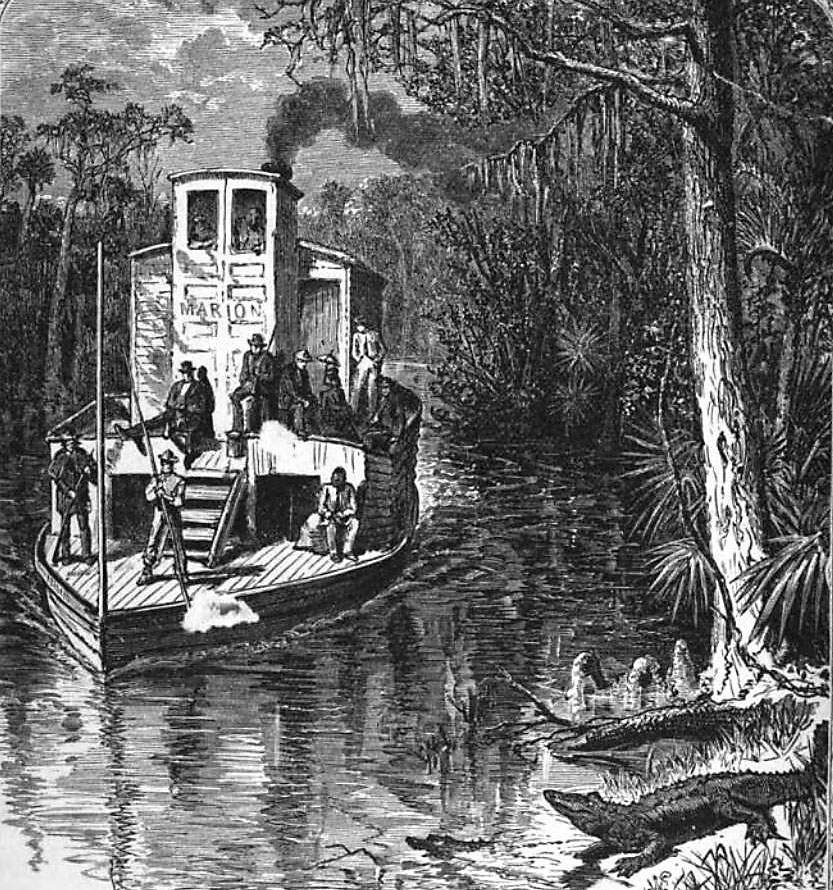
For the next thirty years it was the social center of north Brevard County. Land deals were closed in its parlor. Steamboat captains running the Indian River Inland Navigation Company packet routes overnighted in its rooms. Northern winter tourists, who reached Titusville by taking the St. Johns River steamer to Sanford and then crossing overland through the Enterprise–Salt Lake corridor, used the hotel as their first base before pushing south down the lagoon to Rockledge, Eau Gallie, and the upper Indian River grove settlements.
What the building actually looked like
Period photographs are inconsistent, and several of the most-circulated postcards labeled “Titus House” or “Sand Point Hotel” cannot be confidently attributed. What’s documented from contemporaneous newspaper descriptions: two stories, a wraparound deep porch on at least the south and east elevations (typical of 1870s Florida resort architecture), a central front entrance facing Indian River Avenue, dining room on the ground floor, fifteen to twenty guest rooms upstairs by the early 1880s. Wood frame, painted white in most descriptions, with a wide-board cypress exterior typical of the era.
The bluff orientation matters. The hotel sat above the lagoon by perhaps ten feet of elevation, giving second-floor rooms a long view across the Indian River. On clear days that view ran east to Merritt Island. The Mosquito Lagoon system that would later become Kennedy Space Center was visible on the horizon as a low mangrove line. None of the people sitting on the second-floor porch in 1885 had any reason to think the eastern horizon would matter; the railroad had just arrived, the Indian River steamboats were still the dominant transport, and Cape Canaveral was a lighthouse and a few scattered fish camps.
After Titus’s death
Henry Titus died August 7, 1881. His widow, Mary Hopkins Titus, ran the hotel for several years before selling. The property changed hands multiple times through the 1880s and 1890s; in this period the name “Sand Point Hotel” replaced “Titus House” in most local advertising.
The 1885 arrival of the FEC railroad cut into the Indian River steamboat trade that had supplied the hotel’s guests. Within a decade the steamboats were largely gone, and the hotel had to compete with newer rail-adjacent properties farther south down the FEC line (most notably Henry Flagler’s own hotels in Ormond, St. Augustine, and eventually Palm Beach). The Sand Point Hotel was a small first-generation Florida resort hotel in an era when Flagler was building grand destination resorts. It couldn’t keep up.
The fires and the disappearance
Through the 1890s and early 1900s the hotel suffered multiple fires of varying severity. Wood-frame Florida hotels of the era were almost all eventually destroyed by fire; the Sand Point/Titus House followed the pattern. Period newspaper reports (when Florida Star issues from that era are extant) reference at least two significant fires before 1910.
By the 1920s the lot had been redeveloped. The exact build-and-demolish sequence is poorly documented because the Brevard County courthouse fire of 1894 destroyed earlier records and several gaps in the surviving newspaper run prevent a clean reconstruction. What’s clear: by the time downtown Titusville was paved and motorized in the 1920s, the hotel was gone.
The lot it occupied is part of present-day downtown Titusville’s commercial waterfront. Sand Point Park, on the lagoon waterfront a short walk south, carries forward the older name but is not on the hotel’s original footprint.
Henry Titus the proprietor
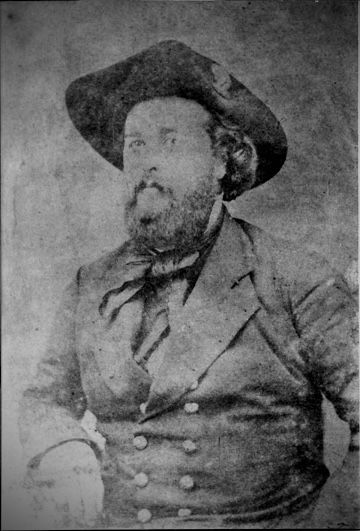
The man running the hotel was not a hotelier by training or temperament. Per Henry Titus’s Wikipedia entry and the underlying biographical record, Titus was born February 13, 1823 in Trenton, New Jersey, and arrived in Florida only after a sequence of failed military adventures: he joined the 1850 to 1851 Narciso López expedition to Cuba, fought with William Walker’s filibuster forces in Nicaragua in 1857, and ran a pro-slavery fort, “Fort Titus,” at Lecompton, Kansas Territory during the Bleeding Kansas period of 1856. He was wounded and captured at Fort Titus on August 16, 1856 by abolitionist forces under James Lane, then exchanged.
When Titus walked into Sand Point in November 1867, he was a 44-year-old veteran of three lost causes, looking for a place to be a legitimate businessman for the first time. The hotel was the second piece of infrastructure he built, after the sawmill and general store. It was also, in the framing of his time, the building that signaled commercial respectability. A man who ran a hotel was a town father; a man who ran a sawmill was a tradesman. Titus needed both, and he built them within a year of each other.
The hotel’s tone was set by who Titus was. Surviving correspondence and contemporaneous Florida newspaper accounts describe a host who was a heavy drinker, a card player, and a storyteller, the dominoes game with Captain Clark Rice in October 1873 that gave the town its renaming, depending on the version, was either played in the hotel’s bar or its parlor. The hotel was the social engine; Titus was its proprietor, not its manager.
What’s left
A handful of photographs in the Florida Memory collection, the Brevard County deed record (fragmentary for the pre-1894 period because of the courthouse fire), and the period newspaper run (incomplete) constitute the documentary record. No physical fabric of the hotel survives. The wood frame, the porches, the dining-room cypress, the second-floor view: all gone.
The hotel matters because of what it represented while it stood. For the first thirty years of Titusville as a named town, it was where the town’s business got done. The dock outside it was the connection point between the Indian River steamboats and overland travel to Sanford. The dining room was where land deals closed. Its disappearance, quietly, in stages, by fire, is the same story as most first-generation Florida resort hotels, including the Indian River Hotel at Rockledge and the Plaza at Cocoa.
What to read for context
The Florida Memory collection holds the best surviving photographic record of Indian River hotels of this era. The Henry M. Flagler papers at the Flagler Museum in Palm Beach (Whitehall) include correspondence touching on competition with smaller pre-FEC hotels in the 1880s and 1890s. Brevard County deed and tax records, where they survive the 1894 fire, document the ownership chain of the Sand Point property through the early 20th century. For broader context on first-generation Florida resort architecture, The Architecture of Wood: Florida’s Vernacular Building Traditions (Florida Heritage Press) covers the construction style with documented examples.
Further Reading
As an Amazon Associate we earn from qualifying purchases.