La Grange Cemetery and the pioneer burials of north Brevard
Founded in the 1850s on the Titusville–Mims line, La Grange Cemetery holds the graves of Henry Titus, Harry and Harriette Moore, and several generations of pre-FEC Brevard pioneers.
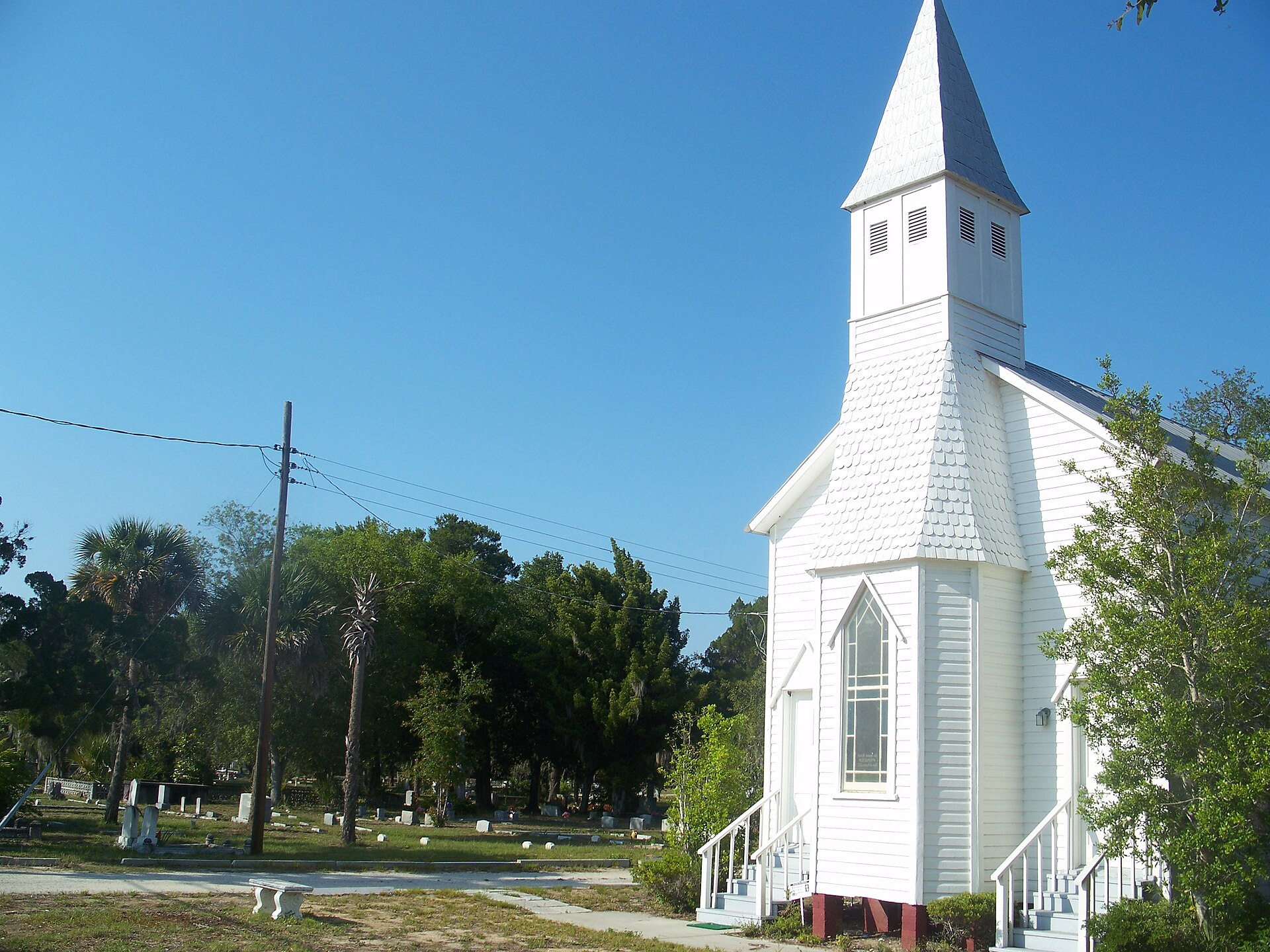
La Grange Cemetery sits on Old Dixie Highway north of Titusville, on what’s now the Mims–Titusville boundary. The cemetery and the adjacent La Grange Community Church complex date to the 1850s. The cemetery is the oldest continuously-used burying ground in Brevard County and contains the graves of Henry Titus, Harry T. and Harriette V. Moore, and several generations of north Brevard pioneer families.
The cemetery is segregated by an original 1850s plan into a white section and a Black section, both still in use, though the practical operation of the cemetery has been integrated for decades and the formal division reflects 19th-century burial customs rather than current operating practice.
The cemetery’s origins
La Grange Cemetery was established in conjunction with the La Grange Community Church, a small Methodist congregation founded in the early 1850s on the route between the Indian River and the St. Johns. The community that gave the cemetery its name was a small settlement on the same ridge corridor that would later support Mims’s citrus economy. La Grange as a separate settlement faded through the late 19th century, absorbed into Mims and Titusville’s expanding boundaries, but the church and cemetery remained.
The earliest documented burials in the cemetery date to the mid-1850s, with several stones from the 1860s and 1870s clearly legible at present. Earlier unmarked or wood-marker burials likely exist but are not documented in the surviving records.
The pre-1894 pioneer graves
For Brevard County genealogical research, La Grange’s value is concentrated in its pre-1894 burials. Because most pre-1894 Brevard County government records were destroyed in the 1894 courthouse fire, the cemetery’s grave markers and surviving church burial registers are among the few continuous documentary sources for the names, dates, and family connections of north Brevard’s pioneer population.
Family names visible in the older sections include the Pritchards, Joyners, Stewarts, Carltons, Cartys, and several others whose surnames recur in Brevard County records into the 20th century. Several of these families had been in the area since before the Civil War; the 1860 federal census, taken under the recently-renamed Brevard County designation, lists many of them among the Sand Point and La Grange residents.
The pre-Civil-War burials include both free residents and a small number of enslaved or formerly-enslaved individuals (the latter often without surnames on early markers, or with surnames adopted post-emancipation). The cemetery’s Black section, formally separated by 19th-century plan, contains burials from the 1860s forward.
Henry Titus’s grave
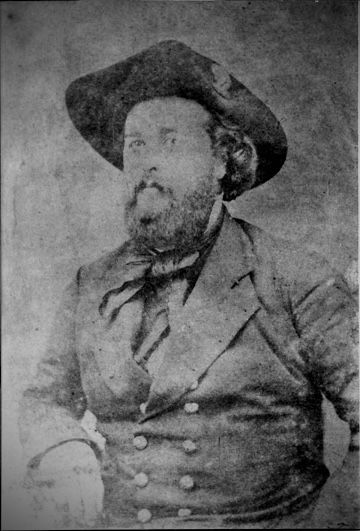
Henry Theodore Titus was buried at La Grange after his death on August 7, 1881. The marker is in the cemetery’s main section and is a modest standing-stone arrangement typical of late-19th-century Brevard burials, not a monumentally larger or more ornate grave than the surrounding pioneer graves. The accompanying Mary Hopkins Titus marker (his widow, who outlived him by decades) is adjacent.
The understated nature of Titus’s grave is somewhat notable given his pre-Florida reputation and his role in naming the town. Whether by family choice or by Titus’s own pre-death instruction, the grave is appropriately scaled to the small Brevard County town he left behind, not the Mexican-American War veteran and Nicaraguan filibuster who had been a national figure in the 1850s.
The Moore burials
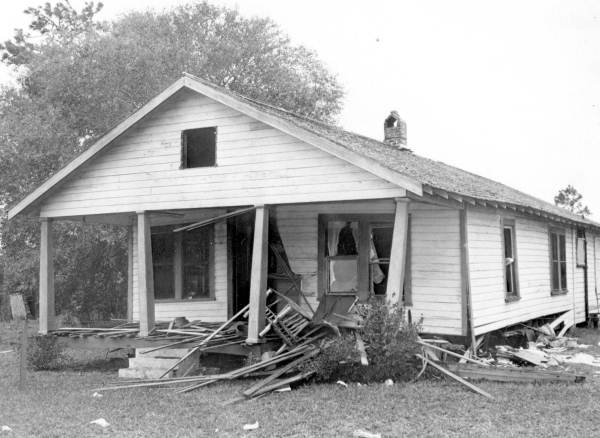
Harry T. Moore (1905–1951) and Harriette V. Moore (1902–1952) are buried in La Grange Cemetery, in a section that has become a pilgrimage site for civil rights history. Their graves are marked with appropriate stones and a small interpretive marker; the Harry T. and Harriette V. Moore Memorial Park in Mims (the home-site memorial, distinct from the cemetery) is the larger public memorial site, but the cemetery is where the actual graves are.
The Moores’ daughter Juanita Evangeline Moore (1930–2015) and the parents (Sarah Ridgway Moore and Johnny T. Moore) are buried in the same family plot or nearby. Members of the extended Moore and Ridgway families have continued to be buried at La Grange through the late 20th century and into the 21st.
The cemetery’s caretakers and the Brevard County Historical Commission maintain the Moore plot. The cemetery is open to the public during daylight hours.
The Black section
The cemetery’s Black section, on the cemetery’s east side, contains burials dating from the 1860s through the present. Many of the older Black-section graves are documented only by their physical markers (some legible, some weathered) and not in the surviving church or county records. Several genealogical-research efforts through the 2010s have attempted to catalog the section systematically; the work is ongoing.
Brevard County’s Black population through the late 19th and early 20th centuries was concentrated in the Mims–Titusville area, with significant numbers of grove laborers and their families. The Black section at La Grange is the principal burying ground for that community for the period before larger 20th-century cemeteries emerged.
The Moores’ choice to be buried at La Grange, in a cemetery that was formally segregated by section in its 19th-century plan, reflects both the cemetery’s centrality in north Brevard’s Black community life and the family’s deep roots in the area going back to the 19th century.
The National Register listing
La Grange Church and Cemetery were added to the National Register of Historic Places on December 7, 1995 (NRHP reference 95001413). Per the National Register nomination documents, the church was built in 1869 in the Carpenter Gothic architectural style by builders including B. J. Mims and J. N. and J. C. C. Feaster. The address is 1575 Old Dixie Highway, Titusville. The church building is privately owned and is no longer in active use; the cemetery remains in operating use.
The Register listing identifies three individuals as the cemetery’s principal historically significant burials: Henry T. Titus (1823 to 1881), described as “pioneer, soldier of fortune, and founder of Titusville”; Harry T. Moore (1905 to 1951), described as a teacher and civil rights activist; and Harriette Moore (1902 to 1952), described as a school teacher and social reformer. The nomination notes that the Moores “were killed by the same bomb,” referring to the December 25, 1951 attack on their Mims home.
The Carpenter Gothic style of the church reflects a national 19th-century vernacular pattern, board-and-batten exterior, pointed-arch windows, steep roof pitch, that traveled with American Methodist and Episcopal congregations as the country expanded westward and southward. The La Grange church is one of the better-preserved examples of the style in central Florida. The builder names on the construction record, Mims and the Feaster brothers, are family names whose descendants are visible elsewhere in the cemetery’s burial record.
Visiting
La Grange Cemetery is on Old Dixie Highway in unincorporated Brevard County, between Titusville and Mims. The cemetery is open to the public during daylight hours; the adjacent La Grange Community Church is still active. The site is well-maintained, with marked plots and a small parking area.
For genealogical researchers, the cemetery’s marker inventory has been partially digitized through Find a Grave and other crowdsourced cemetery databases; original records held by the La Grange Community Church and by the Brevard County Historical Commission are available to serious researchers by appointment.
The cemetery is not a tourist attraction in the conventional sense; it’s a working burying ground that has accumulated 170 years of north Brevard’s population in one place. Henry Titus is in it. The Moores are in it. The families who made up Sand Point before Titus arrived are in it. The families who built the post-freeze citrus economy are in it. The families who staffed Apollo are in it.
What makes La Grange the most historically dense site in north Brevard is exactly that continuity. A walk through it is a walk through the city’s primary-source history in stone.
Further Reading
As an Amazon Associate we earn from qualifying purchases.