The Indian River steamboat era and Titusville as transit hub
Before the FEC railroad arrived in 1885, Titusville was the northern transit point for a hundred-mile lagoon-and-steamboat network that ran south to Jupiter Inlet.
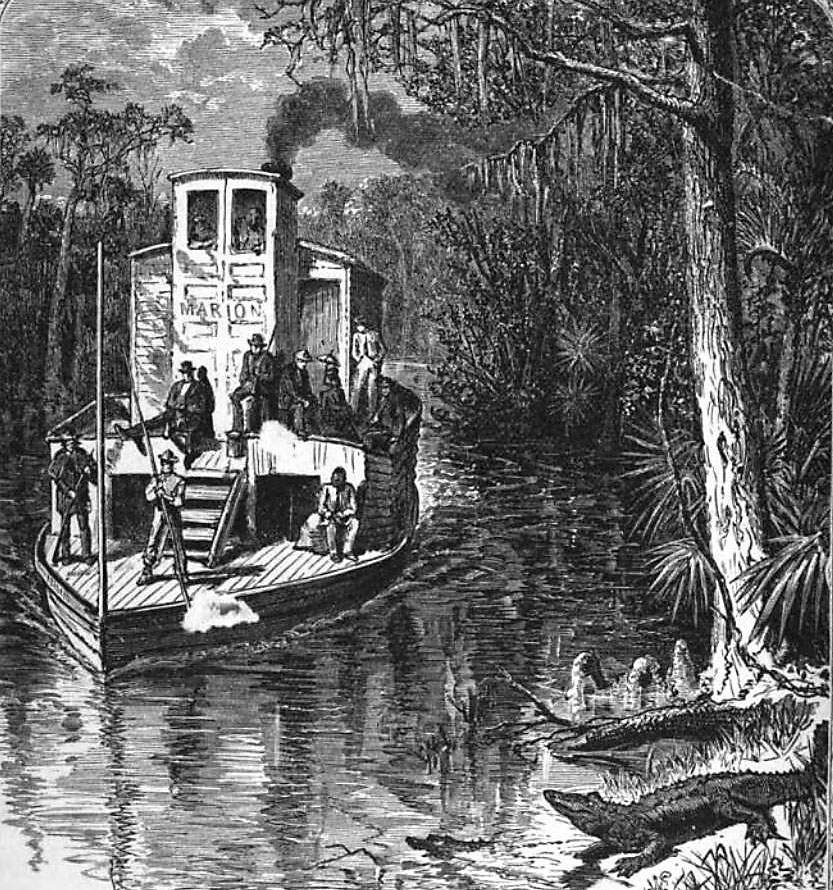
For roughly fifteen years before the FEC railroad arrived in 1885, the Indian River was the main commercial corridor of east-central Florida. Steamboats ran a hundred-mile route between Titusville at the lagoon’s northern end and Jupiter Inlet at the southern end, with regular stops at Rockledge, Eau Gallie, Melbourne, Sebastian, and a dozen smaller grove landings. Titusville was the northern terminus. Everything that left the lagoon for Northern markets passed through the bluff at Sand Point.
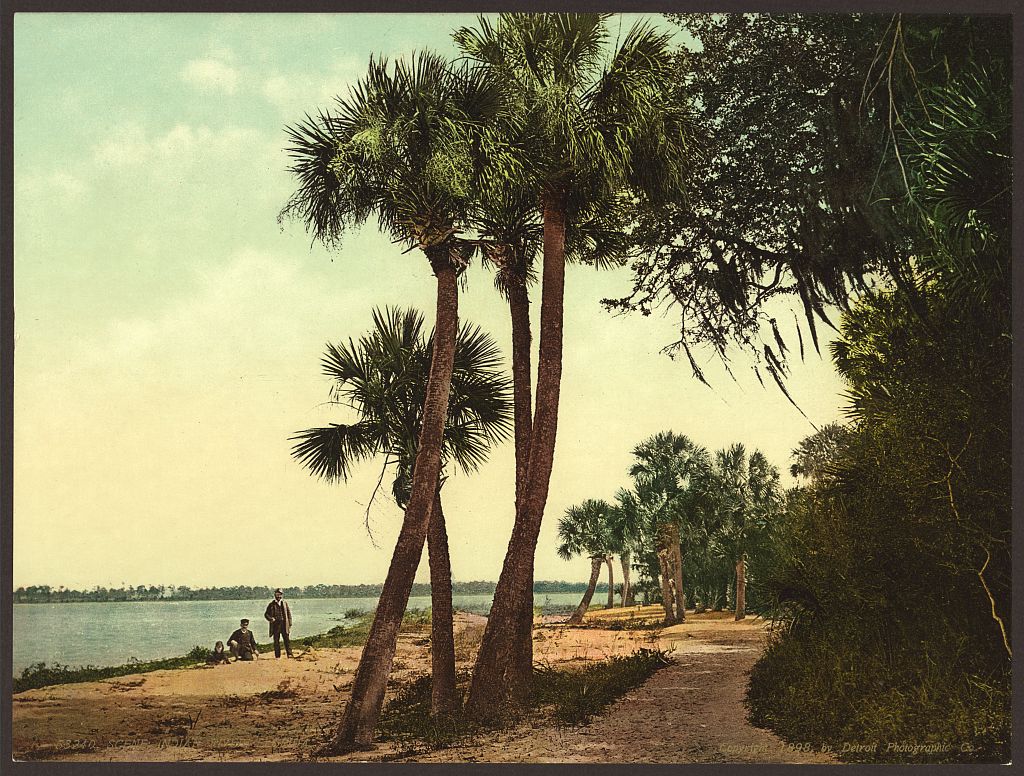
The Indian River is not a river. It’s a brackish-to-saltwater lagoon, a long shallow body of water separated from the Atlantic by the barrier islands that include Merritt Island and the southern Cape Canaveral peninsula. Most of it is two to four feet deep. Steamboats running its length were small, shallow-draft side-wheelers, very different from the deep-water Mississippi or Hudson types of the same period.
The Inland Navigation Company
The most prominent operator was the Indian River Inland Navigation Company (often shortened to IRINCO in surviving correspondence), which by the early 1880s ran a roughly weekly schedule of two or three vessels in regular packet service. Surviving records of the company are fragmentary; the Florida Memory collection holds photographs of several of its steamers, and Army Corps of Engineers reports from the period mention its operations in the context of channel-dredging requests.
Other operators ran independent steamers, typically owner-operator setups carrying grove freight under contract, but the IRINCO packets were the regular passenger and mail service. The U.S. mail contract for the Indian River route was a significant subsidy and a regular subject of dispute among local political factions through the 1880s.
What a trip looked like
The Indian River steamer from Titusville south to Jupiter Inlet in the late 1870s took approximately two days running daylight only (the lagoon was too shallow and too poorly charted to run safely at night for most of its length). Northbound from Jupiter to Titusville against the prevailing wind could take three days.
Cabin accommodations were minimal. Most passengers either traveled deck or, in the better-appointed packets, in small two-bunk cabins with a shared dining table. Meals were prepared by a galley cook and served family-style. Grove freight, pineapples, oranges, occasional lemons and tangerines, was the main cargo southbound (running empty for produce loading) and northbound (carrying produce to the FEC railhead at Titusville for transshipment to Jacksonville and points north).
The Titusville dock was the bottleneck. Everything had to be loaded or unloaded there because everything had to transfer between water and land transport. The bluff above the dock supported the warehouses, the Sand Point Hotel, the small commercial district. For roughly fifteen years that intersection was the most economically active spot on the entire Florida east coast south of St. Augustine.
The end of the era
The FEC railroad pushed past Titusville in the late 1880s. By 1893 the rail line had reached Palm Beach. Each southward extension reduced the steamboat’s competitive territory. By the late 1890s the Indian River steamboat trade was largely gone for freight; passenger service lingered into the early 1900s as a tourist novelty, particularly for fishing and Indian River grove tours, but the commercial era was over.
The shift was rapid because the rail’s time advantage was decisive. A pineapple harvested at Eau Gallie in 1888 could be at New York in roughly five days by rail through Titusville; the same fruit shipped by steamer to Jacksonville before the rail extension to Eau Gallie took eight to ten. For perishable produce, that gap was the difference between a profitable shipment and a partial-loss one.
Several of the IRINCO steamers were sold off, repurposed for short-haul work, or eventually scrapped through the early 20th century. A handful survived as private yachts or charter fishing boats into the 1920s. Photographs in the Florida Memory and St. Lucie County Historical Society collections document several of them at various stages of decline.
What the steamboat era left behind
The Titusville waterfront’s commercial orientation, the warehouses and the dock-adjacent business district that’s still legible in the city’s downtown plan, comes from the steamboat era, not from the rail era. The rail depot was set back from the lagoon by several blocks. Downtown Titusville’s older streets, dating to the 1870s and early 1880s, still run from the bluff edge inland in a pattern that made sense when goods arrived at the lagoon dock and moved inland to warehouses and the hotel.
The channel itself, the Indian River Lagoon, was eventually integrated into the Atlantic Intracoastal Waterway in the 20th century by the Army Corps of Engineers. The same shallow lagoon the steamers worked is now navigated by recreational boaters; the channel has been dredged and marked, but the basic geography (long, shallow, narrow at points, wide at others) is unchanged.
Less well-preserved is the documentary record. The IRINCO’s records did not survive intact. Many local newspapers from the period are missing or in fragmentary runs. Reconstructing schedules, fares, and cargo manifests requires triangulating across what survives in Florida Memory, Army Corps reports, and grove-operator correspondence held in scattered county-historical-society collections.
The lagoon’s geography in numbers
The Indian River Lagoon that the steamers worked is 156 miles long, 0.5 to 5 miles wide, and averages four feet deep, per the lagoon’s published profile. The system runs from Ponce de Leon Inlet at its northern end (south of Daytona Beach) to Jupiter Inlet at its southern end, comprising three connected lagoons: the Mosquito Lagoon, the Banana River, and the Indian River proper. The drainage basin is 2,187 square miles.
Those numbers explain the steamboat constraints directly. A four-foot average depth meant any vessel drawing more than three feet had to thread a marked channel and could not safely cross most of the lagoon’s width. The narrow points, sometimes less than half a mile wide, were the chokepoints where channel maintenance mattered most. The IRINCO’s regular requests to the Army Corps of Engineers for dredging and channel marking trace directly to those geographic limits.
The lagoon’s ecological richness, more than 4,300 species of plants and animals, more threatened-and-endangered species than any other North American estuary, was already a defining feature in the steamboat era. Period grove correspondence references the lagoon’s fish populations and the bird-rookery sites at the larger spoil islands. The Pelican Island National Wildlife Refuge, established by Theodore Roosevelt in 1903 as the first federal wildlife refuge, sits in the southern Indian River Lagoon roughly 70 miles south of Titusville and was protected in part because the late-19th-century plume-hunting industry that had decimated lagoon rookeries was already an obvious crisis to the people working the water.
Why this period matters for Titusville’s identity
Titusville’s role as transit point, as the bottleneck that everything had to pass through, set the city’s later disposition. The town that handled goods moving between two transport modes in 1885 was structurally similar to the town that handled tens of thousands of NASA contractors moving between Brevard County housing and Kennedy Space Center workstations in 1968. The geographic position is the same one. The barrier island, the lagoon, the bluff west of it: those are the constants. What crossed the lagoon changed.
Further Reading
As an Amazon Associate we earn from qualifying purchases.