Henry Theodore Titus and the founding of Titusville, 1867
The Mexican-American War veteran, Kansas border-war partisan, and Nicaraguan filibuster who put his name on a county-seat town on the Indian River.
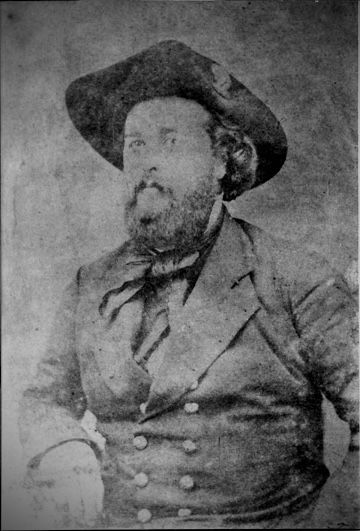
Henry Theodore Titus arrived on the Indian River in 1867 at age forty-four, after a career that included the Mexican-American War, a Nicaraguan filibuster expedition under William Walker, a Kansas border-war title (Colonel of the proslavery faction at the 1856 Battle of Hickory Point), and a stint running steamers on the St. Johns River. He bought up most of Sand Point, the pre-existing settlement on the lagoon’s west shore, built a hotel in 1873, and the U.S. Post Office formally accepted the name Titusville in 1874. He had asked for it. The story that he won the naming rights from a man named Captain Clark Rice in a domino game is local lore the Florida Historical Quarterly has not been able to corroborate from contemporary sources.
The town was a small one when it took his name. Census records and the Brevard County tax rolls of the early 1870s describe a settlement of fewer than a hundred residents around a wood-frame general store, the Titus House (later Sand Point Hotel), a dock for Indian River steamboats, and a scattering of citrus and pineapple plots inland. What Titus brought was promotion. He was, before anything else, a real-estate operator. The hotel pulled Northern winter tourists. The post office pulled mail contracts. The name on the map pulled investors.
Before Sand Point was Titusville
The land Titus arrived at had been called Sand Point for at least a generation. Seminole War-era records reference the site as an army provisioning stop in the 1830s. A small civilian settlement is documented in the 1850 federal census for Brevard County (then Mosquito County, renamed 1855). Among the pre-Titus residents: the Pritchard family, who would later run a Titusville bank; the Stewart family; and several households of free Black residents recorded as boatmen and grove laborers in the 1860 census.
What changed after Titus arrived wasn’t the population, it was the legal and commercial scaffolding. He platted lots. He registered the name. He recruited tenants and buyers. By 1880 the federal census put Titusville’s population at 326, and the same year the county seat moved from Lake Harney to the Indian River town that Titus had branded.
The filibuster years
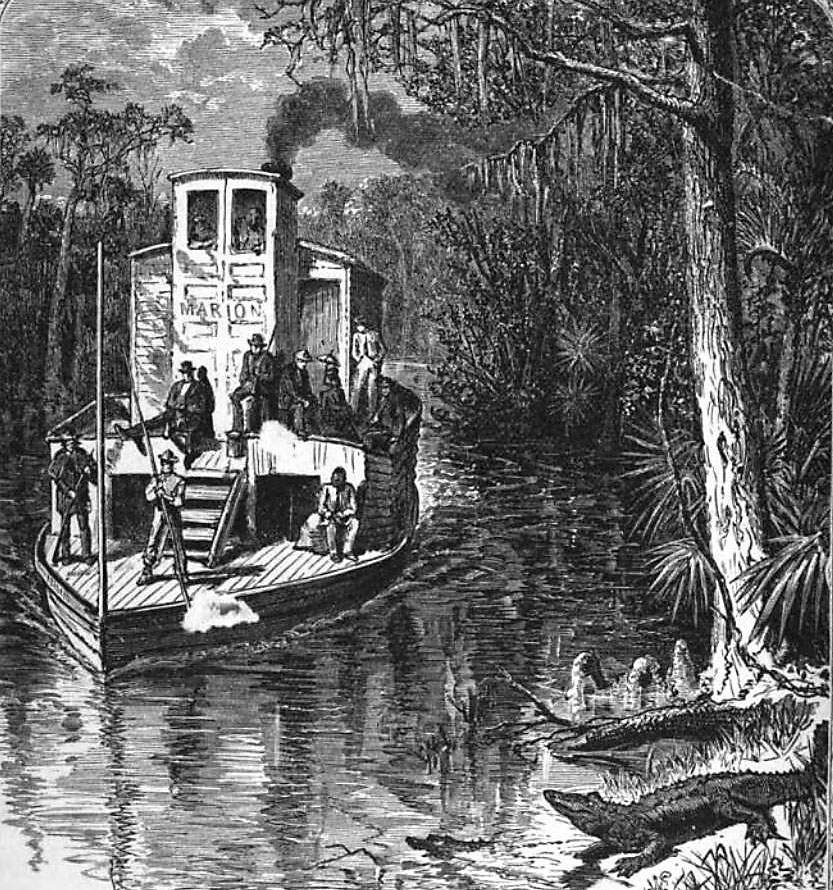
The Florida Historical Quarterly’s 1960 biography by Antonio Rafael de la Cova is the load-bearing source on Titus’s pre-Florida career. De la Cova traces Titus’s involvement in William Walker’s 1856 Nicaragua expedition (Titus arrived after the worst of the fighting, served as quartermaster, escaped the collapse of Walker’s regime by sea), his Kansas activity on the proslavery side during Bleeding Kansas (he led a force that captured the free-state stronghold at Hickory Point in September 1856, was wounded, paraded through Lawrence as a prisoner, eventually exchanged), and his post-Civil War retreat to Florida via a steamer business on the St. Johns.
He came to Florida already infamous, in other words. Northern newspapers in 1856–1857 had used him as a stock villain. The Florida he came to was the post-Reconstruction Florida, where a man with money and a usable identity could re-make himself on the frontier, and where the loyalty tests that mattered in the rest of the country didn’t follow him onto the Indian River.
His politics in Florida appear to have been ordinary white-Democrat-Bourbon for the period. He held no major elected office in Brevard County. He served on the chamber-of-commerce-equivalent business committees that emerged in the 1880s. He was a hotel-keeper and a landlord, not a county boss.

Titus House and the social hub
The hotel Titus built in 1873 went through several names. Locally it was the Titus House. Later it was sold and rebranded the Sand Point Hotel. It stood on the bluff overlooking the Indian River on what’s now Indian River Avenue, a two-story wood-frame structure with deep verandas typical of late-19th-century Florida resort architecture.
For the small Titusville of the 1870s, the hotel was the social center. Land sales were closed in its parlor. Steamboat captains stayed in its rooms between Indian River runs. The town’s volunteer-fire-company organizational meeting in 1885 (after the FEC railroad arrived) was held there. It was the place a Northern tourist taking the St. Johns steamboat to Sanford and then crossing overland to the Indian River would find a familiar register, a familiar bar, and a familiar bill.
The hotel did not survive the 20th century. Multiple fires through the early 1900s damaged the structure; by the 1920s the lot had been redeveloped. No reliable extant photograph identifies the building with full confidence; several attributions in postcard collections are contested.
Death and legacy
Titus died in Titusville on August 7, 1881, at age fifty-eight. He’s buried in La Grange Cemetery north of the city. His widow, Mary Hopkins Titus, ran his property interests for decades afterward; she was a recognized civic figure in her own right through the 1890s and the freeze era.
The town kept his name. Brevard County kept Titusville as the seat through every subsequent attempt to move it (more on that in [a separate article]). The Indian River steamboats kept making Titusville their northern transit point until the FEC railroad arrived in 1885 and bypassed them within a decade.
What Titus left behind was a name and a plat. He didn’t found a railroad, he didn’t write the county charter, he didn’t build the courthouse. He arrived at the right moment in a small Florida frontier town and put his name on the map at exactly the moment Northern tourism, citrus speculation, and rail capital were about to converge on the Indian River. The town that resulted carries his name because he was there in the room when the post office made the decision, and because nobody else fought him for it.
The Fort Titus episode and the Lecompton context
The Kansas engagement Titus is best known for, the August 16, 1856 attack on Fort Titus, was one of the headline events of the Bleeding Kansas period. Per Henry Titus’s biographical record, Titus had “established Fort Titus, a fortified double-log cabin one mile south of Lecompton,” after migrating to Kansas Territory in April 1856 to support proslavery forces. The fort was attacked by abolitionist forces under James Lane. Titus was wounded and captured, then exchanged. The episode put Titus’s name in Northern abolitionist newspapers as a stock villain for the next year, an unfortunate piece of biographical baggage that followed him through the rest of his life.
Lecompton itself was the proslavery territorial capital and the site of the controversial 1857 Lecompton Constitution that would have admitted Kansas to the Union as a slave state. The constitution was rejected by Kansas voters in 1858 and ultimately failed in Congress. Titus’s role in defending the proslavery position at the territorial capital made him a minor figure in the larger national crisis. His subsequent participation in the 1857 Nicaragua expedition under William Walker, the Walker filibuster having sought to establish a slave-holding Central American republic, fit the same political pattern. By the time Titus arrived in Florida in November 1867, the political project he had spent the preceding decade fighting for had been defeated nationally; he was a man whose previous causes had all lost.
The Florida that received him in 1867 was Reconstruction-era Florida, where the Confederate cause was lost but white-Democratic political infrastructure was being rebuilt at the county level. Titus’s politics fit comfortably. His commercial activity in Titusville, hotel, sawmill, store, post office, was the typical Reconstruction-era pattern of a man who had lost the larger fight and was rebuilding personally on a small frontier scale.
What’s verifiable, what isn’t
- Verifiable: birthdate (February 13, 1822, in Trenton, NJ), Mexican-American War service, Walker filibuster role, Kansas activity at Hickory Point, arrival in Florida by the late 1860s, hotel built 1873, post office named 1874, death August 7, 1881. All in the Florida Historical Quarterly biography and de la Cova’s later monographs.
- Tradition only: the Captain Clark Rice domino game. Repeated in local guidebooks; no contemporary newspaper or correspondence has surfaced to confirm.
- Disputed: the precise population of Sand Point in 1867. Different sources put it between 30 and 80; no usable census exists for that year.
Further Reading
As an Amazon Associate we earn from qualifying purchases.