Titusville becomes county seat, 1880
Brevard County moved its seat from Lake Harney to Titusville in 1880. The vote was close, the politics were railroad-shaped, and the change held.
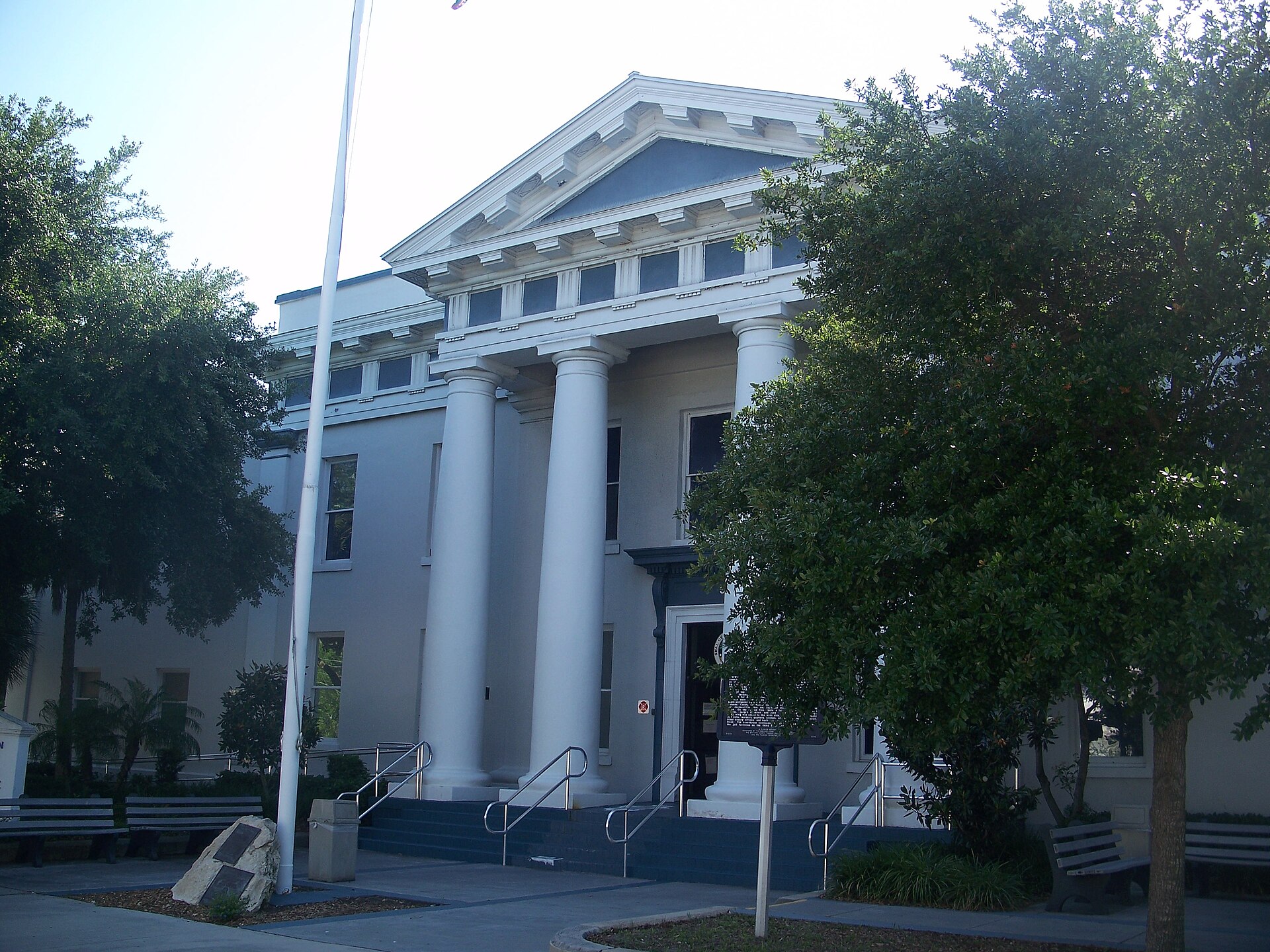
In 1880 the seat of Brevard County moved from Lake Harney, on the upper St. Johns River, to Titusville, on the Indian River. The relocation followed a county-wide vote, was ratified by the Florida legislature in its 1881 session, and effectively created the institutional Titusville that would build a courthouse in 1882, replace it in 1912, and host the county government through every subsequent challenge to its primacy.
Why the move happened, and why it held, is a story about transportation. Lake Harney sits on the St. Johns at the western edge of Brevard County. In the 1850s and 1860s, when the only practical way into central Florida from the north was up the St. Johns by steamer, Lake Harney was a logical waypoint. By the late 1870s the Indian River was emerging as the new commercial corridor, the Atlantic-side route was attracting Northern tourists and grove investors, and Titusville at the Indian River’s northern bend was the natural concentrating point. The seat followed the traffic.
The Lake Harney years
Brevard County (called Mosquito County until 1855) had floated its seat for decades. Mellonville (near present-day Sanford) held it before the 1854 redrawing. After Brevard’s 1855 organization, the seat was located at Susanna, then briefly at Bassville, then at Lake Harney by the late 1860s. Each move was driven by the same calculus: where could county commissioners and a circuit-court judge actually reach by steamboat from where the population was?
Lake Harney’s tenure was short and contested. The 1870 census put the county’s population at 1,216, scattered along the Indian River and St. Johns drainages. By 1880 the population had grown to 1,478, with the center of gravity shifting decisively east toward the Indian River.
The 1880 vote
The Florida legislature in 1879–80 considered several county-seat-relocation petitions statewide. Brevard’s was on the docket because the eastern Indian River grove communities, Titusville, Rockledge, Eau Gallie, Melbourne, had grown enough to outnumber the St. Johns-side population by a margin that made the existing seat inconvenient for most residents and unrepresentative for the tax base.
The vote ran in 1880. Surviving Brevard County records (much was destroyed in the 1894 courthouse fire and an earlier records loss) make a precise vote count difficult to reconstruct from primary sources. Florida General Statutes from the 1881 session confirm legislative ratification of the relocation. The seat moved by 1881 in operational terms, with the county commission meeting in Titusville from that point forward.
Why Titusville and not Rockledge or Eau Gallie
Three Indian River towns had plausible cases: Titusville at the river’s northern bend, Rockledge in the central section, and Eau Gallie at the southern reach. Titusville won for two structural reasons.
First, Titusville was the overland connection between the Indian River and the St. Johns River system. The Salt Lake Road (an ox-cart route west to the St. Johns at present-day Lake Monroe / Sanford) ran out of Titusville. For decades after 1880, until the FEC railroad arrived in 1885 and again until cross-state rail connections matured, the practical way for a Brevard County resident from Lake Harney or the west side to reach the seat was overland to Titusville, not down the Indian River by boat. Titusville’s location was the lowest-friction compromise.
Second, the Sand Point bluff and the existing Titus infrastructure offered the only Indian River town with a stable, non-flooding land base for a courthouse, jail, and government office. The grove communities to the south sat on lower ground and were more vulnerable to lagoon flooding during tropical weather. The bluff at Titusville was high enough, dry enough, and platted enough to host a permanent county facility.
The 1882 courthouse
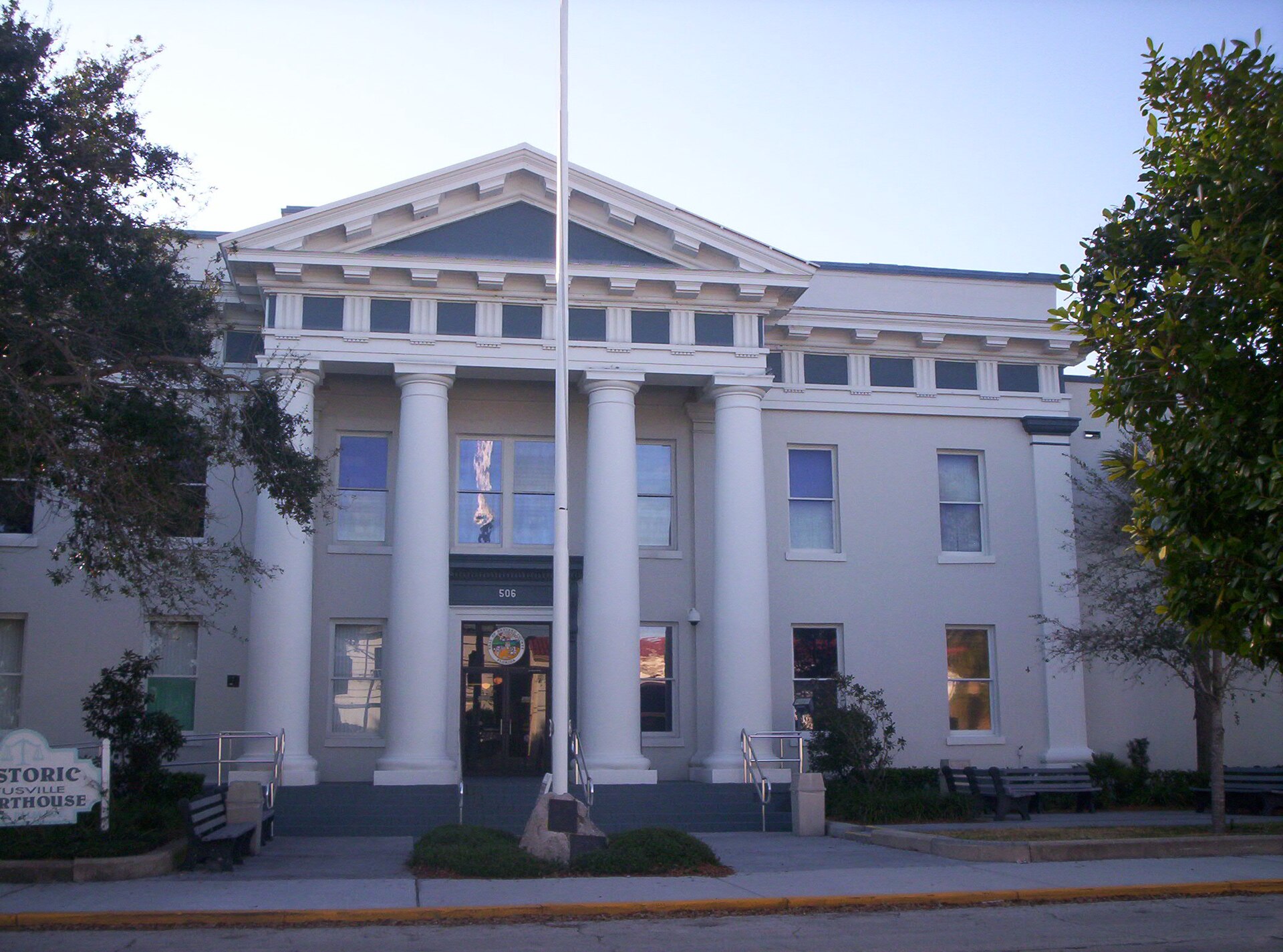
The first Brevard County courthouse in Titusville was a small wood-frame structure built in 1882 at a cost recorded in the county’s surviving 1880s ledgers as approximately $5,000. It burned in 1894, a major loss because most pre-1894 county records went with it. The 1912 brick courthouse (which still stands and is now the Vassar B. Carlton Historic Titusville Courthouse) replaced the wood-frame structure. A modern courthouse complex built in the 1990s now houses active county government; the 1912 building is preserved and used for civic purposes.
Why the seat stayed
Several Brevard County towns made noise about relocating the seat in the 20th century. Cocoa, the largest city by population for much of the 20th century, would have been the most plausible challenger; in the Apollo era a county-seat-to-Cocoa push surfaced periodically. None succeeded. Titusville kept the seat for the same reason it won in 1880: it was the existing center of gravity, the political incumbent, and the relocation cost was always higher than the inconvenience cost.
The pattern of small Florida counties keeping 19th-century seats into the 21st century, Brevard, Volusia, Indian River, Martin, Saint Lucie all do, is the norm, not the exception. The seat moves once. After that, the courthouse, the records, the bar association, the political class are all in one place, and the relocation transaction cost dominates.

The Viera secondary seat, 1989
Brevard County’s modern operating reality is that Titusville is the official seat, but Viera, near the geographic center of the county, is the de facto administrative center. Per the county’s Wikipedia entry, the secondary administration complex at Viera “started in 1989 and completed in 1994” and now houses most day-to-day county operations. Population growth in the southern half of the county, particularly the Melbourne, Palm Bay, and Cocoa corridor, made the old Titusville-only model impractical by the 1980s. The county did not formally relocate the seat. It built a parallel complex and let function migrate without changing the legal designation.
The result is a split. The historic Vassar B. Carlton Courthouse in downtown Titusville remains the official county seat and the venue for ceremonial county business. The Viera complex is where the county commission usually meets, where most permits get pulled, and where most county staff report. Titusville keeps the name and the historic infrastructure; Viera handles the volume.
This is the same outcome the 1880 vote tried to prevent, distance between the population center and the seat. In 1880, Lake Harney was too far west of the Indian River grove communities. By 1989, Titusville was too far north of the Melbourne-area population. The geography that justified Titusville in 1880 became the geography that justified Viera a century later.
What the move did to Titusville
Becoming the county seat in 1880 set the trajectory for Titusville’s next 140 years. Government jobs concentrated. Lawyers and abstract-and-title firms set up. The courthouse pulled the early Pritchard Brothers Bank into a downtown commercial district anchored on Indian River Avenue. The 1885 FEC railroad arrived into a town that already had a courthouse, a hotel, and a settled commercial base; without the 1880 seat decision, the railroad might not have prioritized Titusville at all.
The hotel-town-of-Henry-Titus became the government-town-of-Brevard-County in 1880. Everything else followed.
Further Reading
As an Amazon Associate we earn from qualifying purchases.