Titusville as Apollo gateway: hotels, motels, and the launch crowds
From the early 1960s through the end of Apollo, Titusville sat directly across the Indian River from Pad 39A. The town's hotel and motel inventory tripled to handle the launch tourist surge.
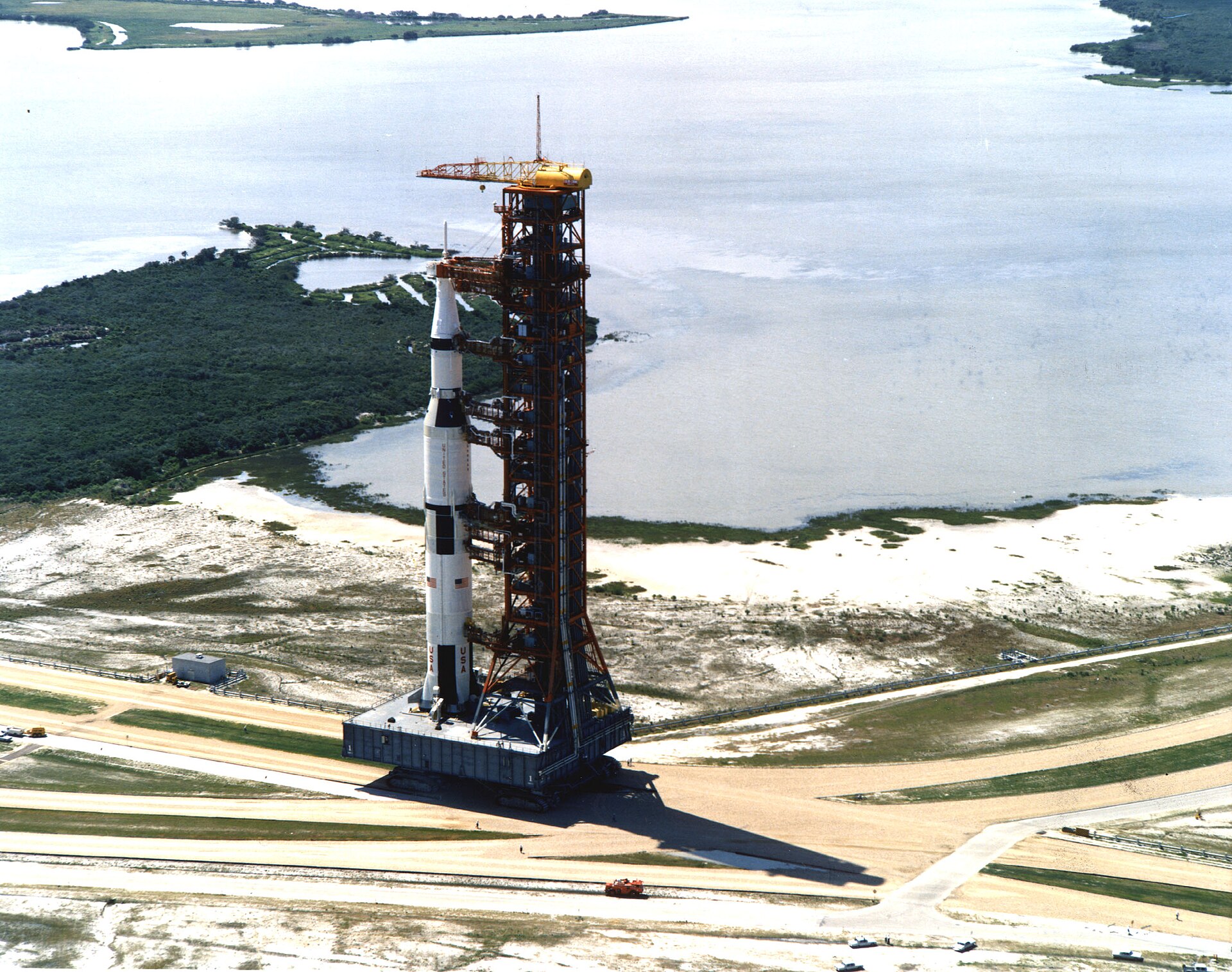
Pad 39A sits about thirteen miles east of downtown Titusville, across the Indian River Lagoon and the Banana River. Through the Apollo program (the lunar missions ran 1968–1972, with Apollo–Soyuz in 1975 as the final Saturn flight), Titusville was the closest major town to the launch pads on the mainland side of the lagoon. The combination of geography and federal hiring drove a hotel-and-motel construction wave that tripled the town’s lodging inventory in less than a decade. The post-Apollo collapse cleared most of it out again.
The geography
Kennedy Space Center occupies most of Merritt Island and the southern portion of the Mosquito Lagoon barrier-island system. Pad 39A and 39B, where the Saturn V launches happened, sit at the northern end of that complex. From Pad 39A, the closest mainland points are at Titusville’s eastern edge (the lagoon shore at Space View Park, the bridge approaches, the riverfront commercial district). Cocoa Beach, the town more often associated with Apollo tourism, sits on the south side of the barrier islands and is closer to Cape Canaveral Air Force Station’s smaller pads but is twenty miles south of 39A.
For launch viewing, Titusville’s geography was preferable for the Saturn missions. The line of sight across the lagoon from the Titusville waterfront put the pad in direct view, unobstructed. Cocoa Beach watched the same launches but from a south-of-pad angle that hid the gantry behind the southern KSC complex.
The hiring surge
NASA Kennedy Space Center’s peak employment during Apollo was approximately 26,000 directly employed plus a comparable number of contractor staff, putting peak total on-site headcount over 50,000 in the 1966–1968 window. That was a workforce roughly equivalent to the entire pre-1960 population of Brevard County.
Most of those workers needed somewhere to live. The federal contractors (Boeing, North American, Douglas, Grumman, IBM, Bendix, RCA, and a hundred smaller subcontractors) ran rotating workforces drawn from across the country. Engineers came in for two-year and three-year assignments. Test technicians and skilled trades came for the duration of specific contracts. The local workforce, Brevard County natives, plus migrants from across Florida and the Southeast, filled the lower-wage technical-support and service positions.
Brevard County’s population went from 23,653 in 1950 to 111,435 in 1960 to 230,006 in 1970, roughly tenfold growth in twenty years, with most of it concentrated in the central and southern Brevard cities (Titusville, Cocoa, Cocoa Beach, Merritt Island, Rockledge). Titusville’s own population went from approximately 2,600 in 1950 to over 30,000 by 1970.
The hotel and motel boom
Titusville’s hotel inventory in 1960 was minimal, a handful of small motels along US-1 and the older central-business-district commercial hotels. By 1968 the town had three dozen motels of various sizes, several new hotel constructions, and a rental-room ecosystem that absorbed thousands of NASA-related visitors during major launches.
The launches were the peak demand events. Apollo 11’s launch on July 16, 1969 brought an estimated one million spectators to the Brevard County area; roughly half watched from the Titusville mainland (Space View Park and the Indian River shore). Hotels and motels in Titusville were fully booked weeks in advance. Rates spiked. The dining rooms ran double shifts. Cars parked across yards and fields rented from property owners running ad-hoc parking businesses.
Apollo 12, 14, 15, 16, and 17 launches each brought launch crowds in the hundreds of thousands. Apollo 13’s launch was less heavily attended (the mid-week April 11, 1970 timing reduced casual tourist turnout), but the rescue mission that followed produced an extraordinary press and visitor surge into Brevard County during the splashdown coverage.
Daily life during the program
Outside the launch peaks, Titusville’s economy was a routine Apollo-era town. The contractor workforce commuted across the Indian River bridges to Kennedy each morning. The bars and restaurants on US-1 and on the older Titusville downtown ran on contractor lunch trade and after-shift evening trade. The local schools enrolled the children of NASA engineers from northern states alongside Brevard County’s native population, producing a strikingly bimodal school demographic through the 1960s.
The town was an engineer town. The standard joke in 1960s Titusville, recorded in Florida Today features of the period, was that you couldn’t throw a rock at a US-1 diner without hitting someone who had a NASA contractor badge.
The crash
The Apollo program ended officially in December 1972 with Apollo 17. Skylab (three missions, 1973–1974) and Apollo–Soyuz (one mission, 1975) used Apollo-era Saturn vehicles but did not require the full Apollo-era workforce. NASA Kennedy’s direct employment dropped from the 26,000 peak to approximately 9,000 by 1975 as contractor work wound down. Total on-site headcount fell by more than half.
The Brevard County economy followed. The 1980 census showed Titusville’s population growing modestly past its 1970 level, but local-economy indicators, vacant motel rooms, closed restaurants, foreclosure rates on the speculative-built mid-1960s housing tracts north and west of the city center, told a different story. Many of the motels built during the 1965–1968 boom closed permanently in the 1970s. Some were demolished; others were converted to long-term residential or weekly-rental SRO use; a handful survived as continuing motels.
The Shuttle program, which started flying in 1981 and ran through 2011, restored some of the launch-event tourism but never the daily-contractor population that Apollo had supported. Shuttle missions launched at a peak of roughly six per year (early 1990s) versus the Apollo peak of three Saturn V launches per year plus extensive ground-test operations. The contractor workforce required for Shuttle was smaller per mission than Apollo. Titusville’s economy through the Shuttle era was structurally smaller than its Apollo peak.
What survives from the boom
The remaining 1960s-era motels along US-1 in Titusville are a visible architectural record of the period. Several have been continuously operating since their original construction; many have been demolished or substantially altered. The mid-century commercial architecture along the older US-1 corridor north of downtown Titusville is a thin layer over the older 1920s and 1930s commercial fabric.
The infrastructure investment from the era, bridges across the Indian River, the Bee Line Expressway (now SR 528) connecting Brevard to Orlando, the expansion of US-1, the upgrade of local water and sewer systems to handle the population spike, is still in use. Most of it was federally funded directly or indirectly through NASA-era spending.
Why Titusville’s Apollo identity stuck
Titusville is sometimes called “Space City USA” in local tourism material. The branding dates to the 1960s and persists. Cocoa Beach has a stronger claim to the “Space Coast” beach-resort identity, but Titusville’s claim to the Apollo-gateway identity is geographically defensible: the mainland-side direct view of Pad 39A, the launch-day crowd flows, the population spike of contractor families, the post-Apollo crash. All of that happened in Titusville at higher proportional intensity than in any other Florida city.
The town that began as a Henry Titus hotel and an FEC depot ended its 20th century as the closest mainland town to humanity’s deepest reach off the planet. The pad is still operational. SpaceX leases 39A and launched Falcon Heavy and Falcon 9 missions from it through the 2020s. The Indian River bluff at Titusville is still the place to stand to watch a Saturn-class vehicle leave the planet.
Further Reading
As an Amazon Associate we earn from qualifying purchases.